
Dealer Management System (DMS) vs. Importer Management System (IMS)

09 December 2025
4 to 5 minutes
Dealer Management System (DMS) vs. Importer Management System (IMS)
How to Make Them Work Together.
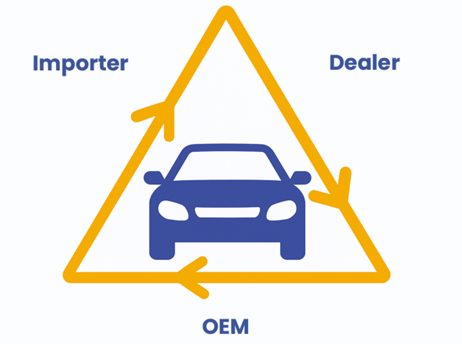
The importer sits at the center of the value chain, using a robust Importer Management System IMS to turn OEM strategy into market reality and keep a multi-brand dealer network supplied, compliant, and profitable. On the other hand, dealers rely on importers for stock, pricing, incentives, parts, warranty, and access to OEM data that feeds directly into their Dealer Management System DMS. Finally, OEMs rely on the IMS for market insight, demand signals, and execution. To make this triangle work, the automotive software solution must match the roles on each side of the triangle.
DMS vs. IMS: Different Jobs, Joined at the Hip
-
Dealer Management System (DMS): This platform runs retail operations, including CRM, sales, service, parts, and accounting.
-
Importer Management System (IMS): This system runs wholesale operations, handling allocation, ordering, pricing/incentives, warranty policies, multi-brand governance, and network performance.
incadea Automotive Insight: If an importer is also a dealer, IMS should extend the DMS and not replace it.
IMS Automotive Software Capabilities That Unlock the Triangle:
- Vehicle & Parts Management centralizes vehicle and parts inventory from the manufacturer to the dealer. It automates orders and updates, replacing manual spreadsheets and phone calls.
- Sales budgets and quotas help set and manage flexible sales goals. It shares forecasts with the manufacturer and can limit dealer orders to prevent overstocking.
- Import Cost Management tracks all import costs, from shipping fees to duties. It provides a real-time view of the total cost per vehicle, allowing for precise tracking against your budget.
- Dealer Claim Management is an automated system for handling all dealer claims, including warranty and service. Dealers submit claims through a portal for quick validation and payment.
- Dealer Portal gives dealers 24/7 online access to vehicle availability, order status, and recalls without exposing the system's back-end complexity.
- Wholesale CRM keeps customer and campaign data consistent across the entire network. It helps manage new product launches and marketing efforts with reliable information.
- OEM Integrations allows the system to easily connect with multiple brands and their data (like models and pricing). It ensures all systems stay aligned and can adapt to changes without a complete rebuild.
Practical Playbook for What Ensures Seamless Collaboration
A) Clear data ownership
- IMS: model/price/policy master, allocations, warranty decisions.
- DMS: customer & transaction truth (sales, service, parts).
- Shared keys: VIN, PartNo, DealerID/BranchID, OrderID, CustomerID (consent-aware).
B) Modern integration patterns
- Bulk nightly for heavy catalog and price updates.
- Real-time APIs for orders, claims, and vehicle allocations.
- Eventing/webhooks for status changes (OrderPlaced, VINAllocated, ClaimApproved).
Contracts: OpenAPI, versioning, retries, and SLAs.
C) One network portal
A single entry point for dealers to place orders, submit claims, check availability, and view KPIs minimizes email and duplicate outreach.
D) Shared KPIs & SLAs
- Integration: delivery success ≥99.9%, P95 event latency <5s, catalog freshness T+1.
- Business: lead response time ↓, RO conversion ↑, warranty cycle time ↓, fill rate ↑, and dead stock↓.
E) Governance without drag
A small “control tower” (Importer + OEM + dealer reps) with a change calendar, RACI, and monthly review of defects, retries, and top impediments.
So What Good Looks Like (Two Flows)
Warranty: Repair Order completed in DMS → claim pack auto built → IMS rules validate → decision returned → credit memo applied to dealer account. Full traceability, zero email.
New Vehicle Allocation: Dealer submits demand → IMS confirms VIN-to-option matches → ETA and pricing/incentives flow back to DMS → sales use livestock without re-keying.
Seamless collaboration isn’t DMS vs. IMS, it’s DMS + IMS, each doing its job and talking through a thin, reliable contract. With the importer orchestrating data, rules, and integrations, the entire triangle moves faster and better serves customers.
Do you want to learn more about the incadea Importer Management System?
Visit our Business Solutions page to learn more about incadea IMS.
Dr. Juraj Hanus
incadea SME DMS | juraj.hanus@incadea.com
Data Analytics & Automotive Applications Expert for Dealerships
09 December 2025
4 to 5 minutes
